




ISRO’s PSLV-C58 has launched XPOSAT Satellite into an Eastward low inclination orbit on January 01, 2024 09:10 Hrs IST.
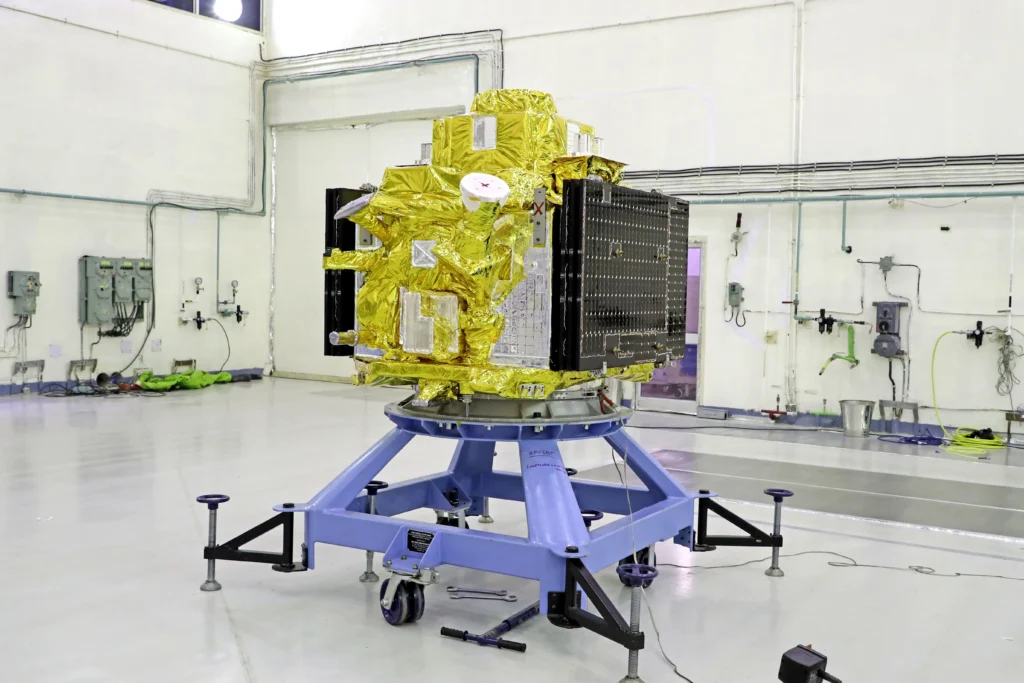
After injection of XPOSAT, the PS4 stage will be re-started twice to reduce the orbit into 350 km circular orbit to maintain in 3-axis stabilized mode for Orbital Platform (OP) experiments. The PSLV Orbital Experimental Module-3 (POEM-3) experiment will be executed meeting the objective of 10 identified payloads, supplied by ISRO and IN-SPACe.
The objectives of this mission are:
- To measure polarisation of X-rays in the energy band 8-30keV emanating from about 50 potential cosmic sources through Thomson Scattering by POLIX payload.
- To carry out long term spectral and temporal studies of cosmic X-ray sources in the energy band 0.8-15keV by XSPECT payload.
- To carry out polarisation and spectroscopic measurements of X-ray emissions from cosmic sources by POLIX and XSPECT payloads respectively in the common energy band.

XPoSat (X-ray Polarimeter Satellite) is India’s first dedicated polarimetry mission to study various dynamics of bright astronomical X-ray sources in extreme conditions. The spacecraft will carry two scientific payloads in a low earth orbit. The primary payload POLIX (Polarimeter Instrument in X-rays) will measure the polarimetry parameters (degree and angle of polarization) in medium X-ray energy range of 8-30 keV photons of astronomical origin. The XSPECT (X-ray Spectroscopy and Timing) payload will give spectroscopic information in the energy range of 0.8-15 keV.
The emission mechanism from various astronomical sources such as blackhole, neutron stars, active galactic nuclei, pulsar wind nebulae etc. originates from complex physical processes and are challenging to understand. While the spectroscopic and timing information by various space based observatories provide a wealth of information, the exact nature of the emission from such sources still poses deeper challenges to astronomers. The polarimetry measurements add two more dimension to our understanding, the degree of polarization and the angle of polarization and thus is an excellent diagnostic tool to understand the emission processes from astronomical sources. The polarimetric observations along with spectroscopic measurements are expected to break the degeneracy of various theoretical models of astronomical emission processes. This would be the major direction of research from XPoSat by Indian





More Stories
Post Union Budget 2025-26 Reaction Quote: Omega Seiki Pvt. Ltd
Air India enhances global Air travel with A350
2023 Budget reactions from EV Industry